When comparing new air conditioners, SEER2 is one of the numbers homeowners are likely to see first. It can be useful for comparing the energy efficiency of different cooling systems, but the number does not tell the whole story. A system with a higher rating is not automatically the best choice for every house.
The efficiency you experience at home depends on much more than a laboratory rating. Equipment sizing, ductwork, installation quality, insulation, airflow, climate, and even how you use the thermostat can affect performance. For Utah homeowners, the goal should be to understand what the rating tells you, then consider it alongside the factors that determine how the complete cooling system will actually operate.
What Does SEER2 Measure?
SEER2 stands for Seasonal Energy Efficiency Ratio 2. It measures how efficiently an air conditioner or heat pump provides cooling over a simulated cooling season. In basic terms, it compares the amount of cooling produced with the electricity consumed to produce it.
Homeowners who want to dig into the federal standards can review the U.S. Department of Energy’s guidance for understanding SEER2 ratings. The rating gives consumers a standardized way to compare residential cooling equipment.
SEER2 replaced the older SEER rating as part of updated federal testing procedures. One significant change involves testing equipment under conditions with greater external static pressure. This is intended to better represent the resistance an HVAC system encounters when pushing conditioned air through residential ductwork.
If two appropriately sized systems are compared under the same testing standards, the model with the higher SEER2 rating is designed to use less electricity to provide a given amount of seasonal cooling.
That makes the rating useful. It just does not make it a complete measure of HVAC system efficiency inside a particular home.
Why Higher SEER2 Is Not Automatically Better
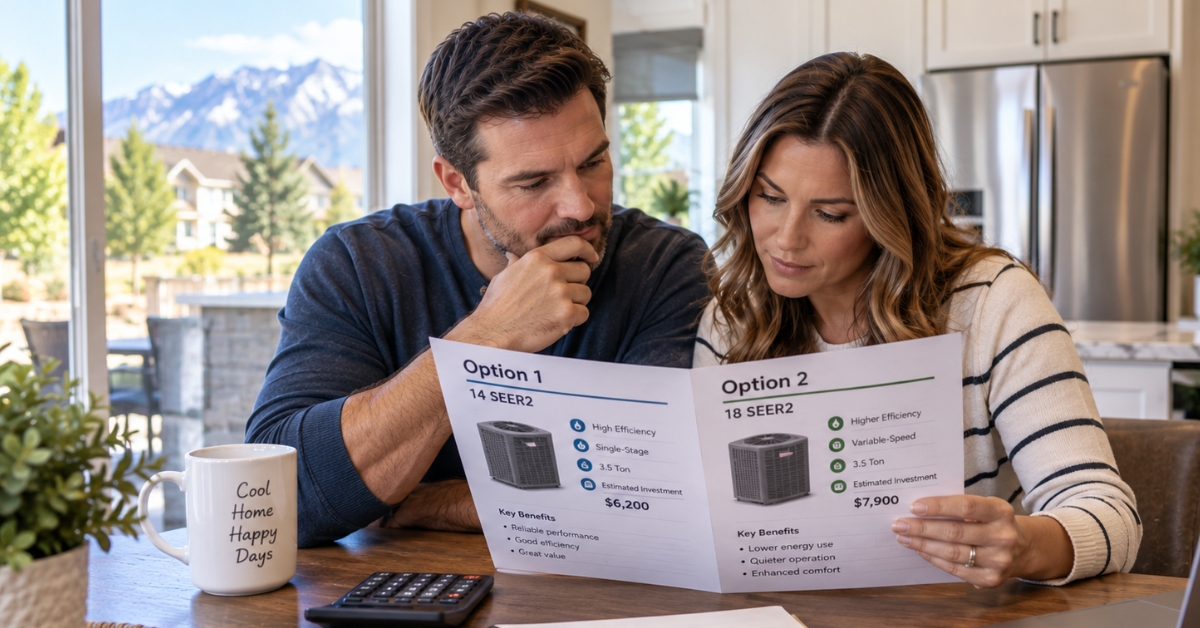
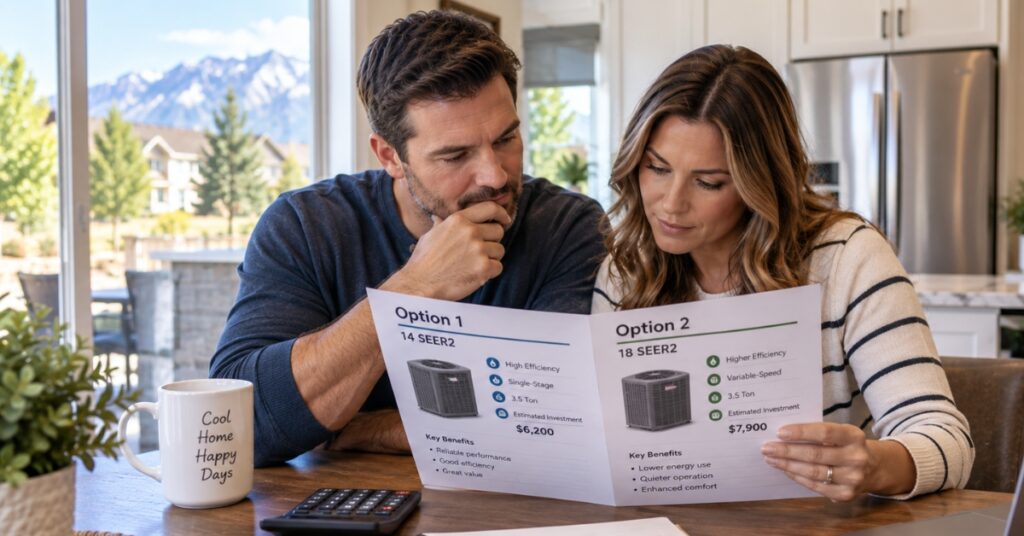
It is easy to look at two systems and assume that the one with the higher number is the obvious choice. In reality, there is a financial tradeoff to consider.
Higher-efficiency equipment can cost more upfront. That additional investment may make sense for a homeowner who uses central air conditioning extensively during the summer and expects to remain in the home long enough to benefit from reduced energy consumption.
For another homeowner, the difference in operating costs between two efficiency levels may be relatively small compared with the difference in purchase price.
This is why it helps to understand new AC costs before focusing too heavily on one specification. Equipment efficiency is only one factor in the total installed price.
Capacity, equipment type, installation complexity, electrical work, modifications to existing components, and other project requirements can all affect the final cost of a new cooling system.
Compare the Investment With Expected Use
The value of a higher SEER2 rating partly depends on how much the air conditioner will run.
A home that requires substantial cooling throughout a hot Utah summer creates more opportunities for improved energy efficiency to reduce electricity consumption. A home that needs relatively little mechanical cooling may have a smaller difference in annual operating costs between two efficiency levels.
Homeowners should therefore consider the price difference between systems alongside expected usage, electricity rates, how long they plan to own the home, and the condition of the existing HVAC system.
The objective is not necessarily to buy the highest SEER2 number available. It is to choose an efficiency level that makes sense for the home and the homeowner’s priorities.
Proper System Sizing Can Change the Equation
An air conditioner can have an impressive efficiency rating and still be a poor fit for a house if its cooling capacity is wrong.
Capacity and efficiency measure different things. SEER2 addresses how efficiently equipment produces cooling. System sizing determines how much cooling capacity the home needs.
This distinction explains why sizing matters when evaluating a new air conditioner.
An oversized air conditioner may cool a home rapidly and then shut down, resulting in shorter operating cycles. Frequent cycling can affect comfort, equipment wear, and the system’s ability to maintain consistent indoor conditions.
An undersized unit presents the opposite problem. It may run for long periods during hot weather while struggling to bring the home to the thermostat setting.
Square Footage Is Only Part of Sizing
Home size matters, but choosing equipment based solely on square footage overlooks important variables.
A cooling load calculation can account for factors such as:
- Insulation levels
- Window size and orientation
- Air leakage
- Ceiling height
- Building materials
- Sun exposure and shading
- Number of occupants
- Local climate conditions
Two Utah homes with the same square footage can have substantially different cooling requirements.
A properly sized system has a better opportunity to operate as intended. Paying for additional energy efficiency while ignoring capacity can undermine the reason for choosing more efficient equipment in the first place.
Ductwork Influences Real-World Efficiency
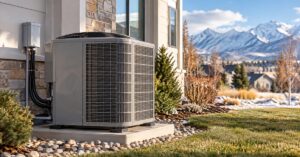
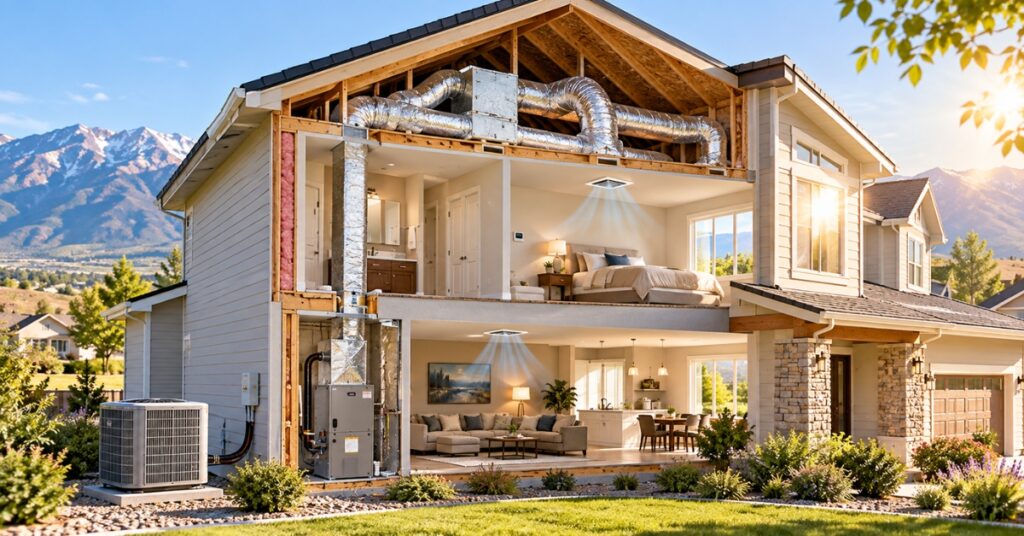
The condenser unit outside the house is only one component of central air conditioning. Conditioned air still has to travel through the home’s duct system and reach individual rooms.
Problems in that distribution system can reduce real-world performance.
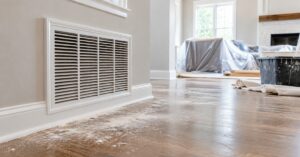
Leaky ducts may allow cooled air to escape into an attic, crawlspace, garage, or another area where it does little to improve indoor comfort. Poorly insulated ductwork can also gain heat before conditioned air reaches the living space.
Restrictions create another concern. Ducts that are undersized, damaged, poorly configured, or obstructed can interfere with airflow.
When airflow is inadequate, even high-efficiency equipment may struggle to perform as expected.
Higher Efficiency Cannot Repair Bad Ductwork
A higher SEER2 rating does not compensate for significant air leakage or poor duct design.
If a homeowner is considering investing in higher-efficiency equipment, evaluating the existing duct system can provide valuable context. In some cases, sealing leaks, correcting airflow restrictions, or improving insulation around ducts may help the new equipment perform closer to its intended capabilities.
This is also why HVAC comparisons should consider the complete system rather than treating the outdoor condenser as an isolated appliance.
Installation Quality Matters After the Equipment Is Selected
SEER2 is determined through standardized testing. It cannot account for the quality of installation at an individual property.
Several installation details can influence the performance of a new air conditioner. Refrigerant charge needs to be correct. Airflow must be properly established. Electrical connections, condensate drainage, thermostat controls, and indoor and outdoor components need to work together as designed.
Equipment placement matters as well. The condenser needs appropriate clearance and a stable installation location.
A problem in any of these areas can affect efficiency or reliability regardless of the rating printed on the equipment.
Equipment Matching Matters Too
An HVAC system consists of multiple components.
The outdoor condenser, indoor evaporator coil, blower, furnace or air handler, thermostat, and duct system all influence how cooling is delivered. Published efficiency ratings can depend on particular combinations of indoor and outdoor equipment.
This is an important detail when comparing replacement options. Homeowners should know what equipment combination is being proposed rather than assuming that the rating of one component represents the performance of every possible configuration.
How Utah’s Climate Affects the Value of Efficiency
Utah’s summer temperatures can create significant demand for residential cooling, but that demand is not identical from one house to another.
Elevation, sun exposure, insulation, window performance, air leakage, landscaping, and thermostat preferences can all influence how often an air conditioner operates.
A house receiving intense afternoon sun may require considerably more cooling than a shaded home nearby. Likewise, a well-insulated property with good air sealing may retain conditioned air longer than an older or less efficient home.
This matters when considering whether it is worthwhile to pay more for a higher SEER2 system.
The more frequently cooling equipment operates, the more opportunity there is for greater energy efficiency to affect electricity consumption. If cooling demand is relatively modest, it may take longer for potential energy savings to offset a higher purchase price.
What SEER2 Cannot Tell You About Comfort
One of the most important limitations of SEER2 is that it is an energy efficiency measurement, not a complete comfort rating.
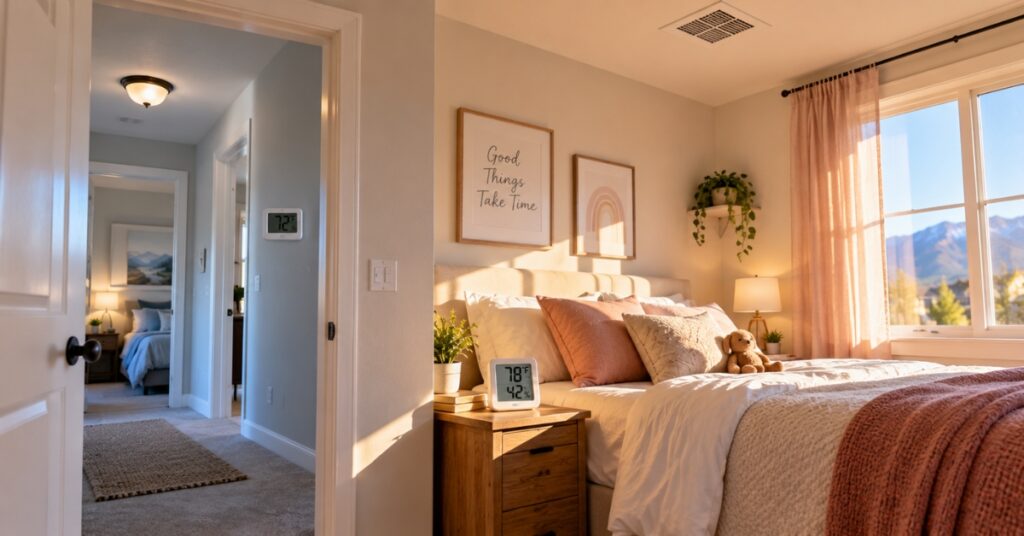
The number cannot tell you whether one bedroom will remain warmer than another. It does not indicate whether an upstairs level has poor airflow, whether the system will be noticeably quiet, or whether the thermostat is located in a representative part of the house.
Those issues can be influenced by system design, ductwork, equipment features, controls, insulation, and the characteristics of the building itself.
Some cooling systems also offer features such as variable-speed or multi-stage operation. These technologies can affect how a system responds to changing cooling demands, but homeowners should evaluate those capabilities separately instead of assuming a higher SEER2 number automatically means better comfort.
What About Energy Star Equipment?
Energy Star and SEER2 are related to energy efficiency, but they are not the same thing.
SEER2 is a measurement used to express seasonal cooling efficiency. Energy Star is a federal program that identifies products meeting specified energy-efficiency criteria.
An Energy Star designation can be another useful piece of information when comparing systems, but it still does not replace proper sizing, installation, duct evaluation, or consideration of the home’s cooling requirements.
Homeowners should think of labels and ratings as comparison tools rather than guarantees of a particular utility bill or comfort level.
How to Compare New Cooling Systems More Effectively
Instead of starting with “Which air conditioner has the highest SEER2?”, homeowners can ask a broader set of questions.
First, determine how much cooling capacity the house actually requires. Then consider the efficiency ratings of appropriately sized options.
Next, look at the existing ductwork. Are there known leaks, airflow problems, poorly conditioned rooms, or other issues that should be addressed during the replacement?
Compare total installed prices rather than equipment prices alone. A higher-efficiency model may include technology or installation requirements that affect the overall project cost.
It can also help to ask how the quoted efficiency was determined and whether it applies to the exact indoor and outdoor equipment combination being proposed.
Finally, consider the house itself. Insulation improvements, air sealing, window treatments, and other measures that reduce cooling demand can influence how hard the HVAC system has to work.
Give SEER2 the Right Amount of Weight
SEER2 gives homeowners a valuable standardized measurement for comparing cooling efficiency. It can help distinguish equipment that requires more or less electricity to produce cooling under established testing conditions.
What it cannot do is tell you how well an air conditioner will perform in your particular home by itself.
A slightly lower-rated system that is correctly sized, properly installed, and supported by good airflow may be a more sensible choice than paying for a much higher rating while leaving significant problems elsewhere in the HVAC system unaddressed.
When evaluating a new air conditioner, use SEER2 as one part of the comparison. Consider the rating alongside system capacity, installation quality, ductwork, Utah’s cooling demands, equipment features, and total project cost. Together, those factors provide a much clearer picture of what you are actually buying.
Frequently Asked Questions About SEER2
Is a higher SEER2 rating always worth paying for?
Not necessarily. Higher-efficiency equipment may reduce electricity consumption, but the financial value depends on the additional purchase cost, cooling demand, electricity rates, system condition, and how long you expect to use the equipment.
Does SEER2 tell me how much my electric bill will decrease?
No. SEER2 allows homeowners to compare equipment efficiency under standardized conditions. Actual electricity use depends on weather, thermostat settings, home construction, insulation, ductwork, equipment sizing, electricity rates, and usage habits.
What is the difference between SEER and SEER2?
Both measure seasonal cooling efficiency. SEER2 uses updated testing procedures, including conditions intended to better represent the external static pressure encountered in residential HVAC systems.
Does a higher SEER2 system cool a house faster?
Not necessarily. Cooling capacity and energy efficiency are separate characteristics. How quickly a home cools depends on equipment capacity, current indoor conditions, outdoor temperatures, airflow, and the home’s cooling load.
Can poor ductwork reduce the benefits of a high-efficiency AC?
Yes. Leaky, restrictive, poorly insulated, or improperly sized ducts can reduce the effective performance of a cooling system. The condition of the air distribution system is an important part of overall HVAC system efficiency.
Does SEER2 determine what size air conditioner my home needs?
No. SEER2 measures efficiency, not required cooling capacity. Proper sizing should be based on the home’s cooling load and relevant building characteristics.
Should Utah homeowners prioritize SEER2 when replacing an AC?
It should be an important consideration, but not the only one. Utah’s summer cooling demand can make efficiency valuable, while system sizing, ductwork, installation quality, home efficiency, and total cost also affect the value and performance of a replacement system.